
bringing home a breeding ram
-
When you add a breeding ram to your flock, the incredible experience of seeing lambs born on your farm is just around the corner!
A good ram can be an amazing asset to your flock for many years. With proper management, they are hardy, uncomplaining, regal animals that play an essential role in a healthy breeding program.For most shepherds starting a small flock, keeping a breeding ram is fairly straightforward. In many cases, small flock owners keep a ram in with their ewes year-round (aside from active lambing season). This greatly reduces management challenges that can come with multiple rams, multiple breeding groups, and/or keeping open (unbred) ewes nearby during breeding season.
Before you bring a ram home, it’s important to understand that intact breeding males have different instincts, behaviors, and infrastructure considerations than ewes or wethers.
-
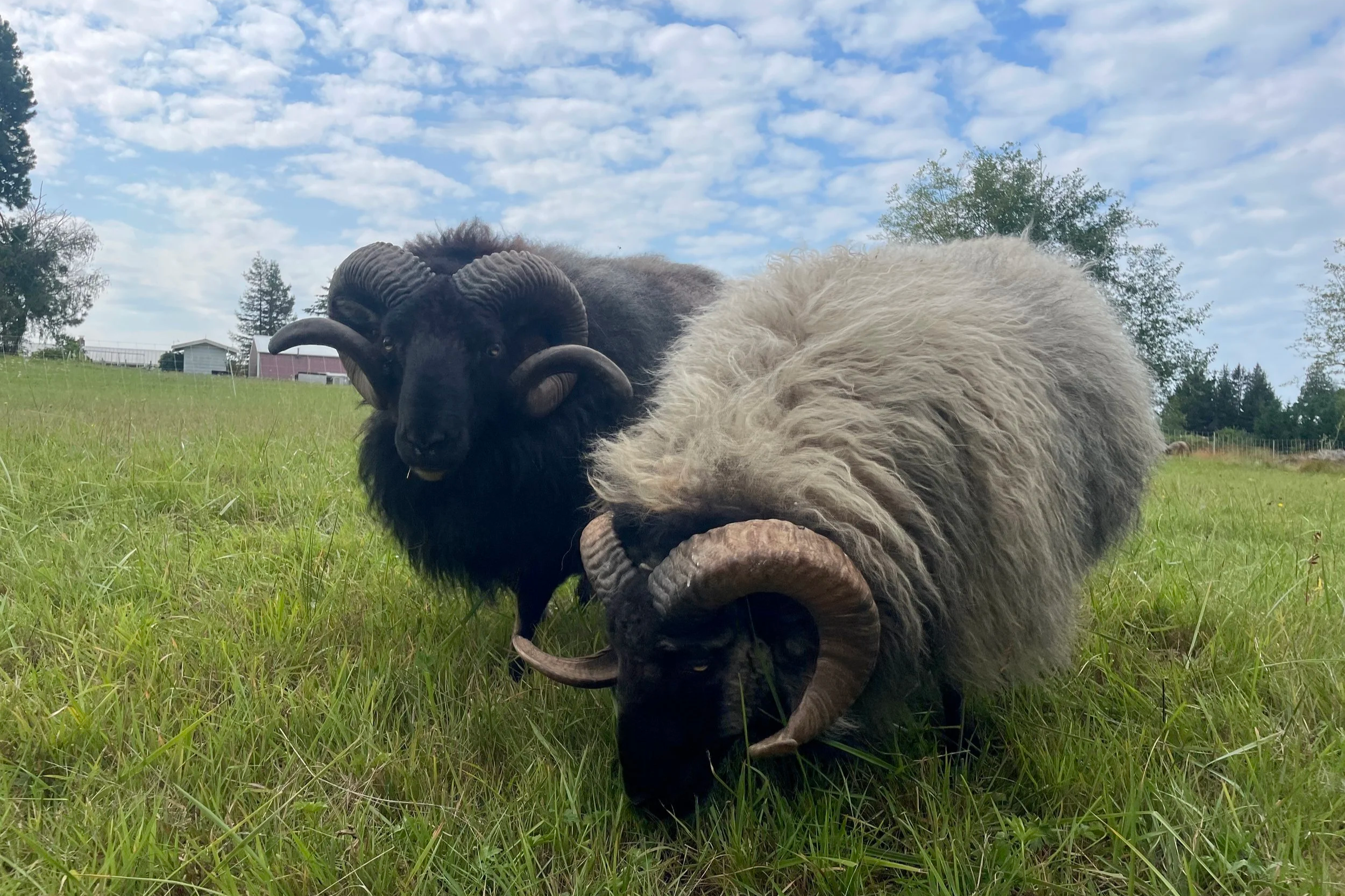
Outside of breeding season, Icelandic rams are often calm, low-maintenance, easy keepers. They generally require the same housing and daily care as the rest of the flock.
But behavior can change dramatically during breeding season — a phenomenon one of my mentors affectionately refers to as “testosterone poisoning.”
It’s important to understand, properly manage, and work to accommodate these behaviors so they can be expressed naturally — and don’t become a liability. That being said, some genuinely aggressive rams simply will not be good candidates for your (or any) farm. For example, an animal that threatens to ram you every time you enter the pen and doesn’t respond to training is probably better sent to the freezer. -
For small flocks where the ram lives with the rest of the flock full-time, housing is usually very simple and low-drama.
But challenges can happen when farms begin keeping multiple breeding groups for genetic diversity, or keep unbred (“open”) ewes nearby during breeding season. In these cases, it’s very important to keep breeding groups as far away from each other — and from unbred groups — as possible.
To a breeding ram, an open ewe nearby is basically a biological emergency. Even if he already has his own breeding group, the smell of an unbred ewe can act like a bat-signal for his instincts. (aka “His princess is in another castle.”)Individual motivation levels vary tremendously from ram to ram. Some rams are fairly relaxed and stay politely with their own groups. Others will make Herculean efforts and be VERY hard on the furniture in order to reach open ewes.
During breeding season, when ewes are still actively cycling nearby (but outside of where the ram is kept) highly motivated rams may:
Bash gates
Damage fencing
Jump or challenge weak barriers
Ram buildings or doors
Fight neighboring rams
This is not necessarily “bad” behavior — it’s what intact breeding males are biologically wired to do — but it does require mindful management to prevent injury and frustration.
If you plan to keep multiple breeding groups, separate intact rams, or keep open ewes on your farm, secure enclosures and thoughtful setup become extremely important (read: as much distance as possible between breeding groups and unbred ewes).
A Good Ram Setup Includes:If a ram is not being kept with the ewes year round:
Separate winter housing for the ram(s), and a plan that ensures the ram does not live alone (e.g. a wether buddy or another breeding ram)
Secure fencing and gates in good repair
Safe handling practices
Realistic expectations about seasonal behavior
A willingness to respect the instincts of intact breeding animals
If you’re new to shepherding, I’m always happy to help talk through whether a ram is the right fit for your flock setup and management goals.
-
A crucial piece of advice another shepherd shared with me early on: The ideal ram behavior is that you walk into a paddock and the ram neither approaches you nor runs from you.
To achieve this, I strongly discourage treating rams and ram lambs like pets — even when they are tiny, affectionate little fuzzballs.Excessive petting, hand-feeding treats, encouraging head-butting, or allowing young ram lambs into your personal space can create dangerous behavioral issues later on. A ram that learns humans are appropriate social or dominance partners may become pushy or aggressive as he matures.
Ram temperament can also change significantly with age. Some remain calm their entire lives. Others become increasingly “rammy” as mature breeding adults.
For safety:
Never turn your back on a ram, even if you know them well
Respect their size and strength
Avoid encouraging overly familiar behavior
Supervise children carefully around breeding animals
-
Many ram lambs are incredibly sweet, calm, and affectionate throughout their first year of life. It’s very common for new shepherds to assume this early behavior reflects how the ram will behave permanently as an adult.
Sometimes it does, sometimes it absolutely doesn’t!
Mature adult rams often display much more dramatic behavioral and hormonal changes during breeding season than young ram lambs do. A polite yearling may become substantially more intense, dominant, or reactive as a mature adult breeding ram.
Because of this, some shepherds choose to keep mature adult rams housed with younger ram lambs or wethers outside of breeding season. Adult rams can provide companionship and social structure, and young rams often learn appropriate flock behavior from mature animals.
However, breeding season can complicate these dynamics considerably.
As testosterone rises in the fall, adult rams may become far less tolerant of younger males. Fighting, intimidation, and injury risk can increase — especially if nearby ewes are cycling or if multiple mature breeding rams are housed together.
Some adult rams coexist peacefully with younger males year-round. Others become extremely competitive during the rut.
As with most ram management, individual personality matters enormously. If you plan to keep multiple intact males together, especially mature breeding rams, it’s wise to:
Have backup separation pens available
Monitor flock dynamics closely during breeding season
Avoid keeping breeding groups close together
Ensure fencing is strong and secure
Be realistic about the possibility that compatible groups may suddenly stop being compatible during the rut
A peaceful bachelor group in summer can become a very different situation by November.
-
Icelandic sheep are seasonal breeders, meaning ewes naturally cycle in the fall as daylight shortens.
In the Pacific Northwest, I generally put breeding groups together from about November 1 through December 1 for April lambs. This timing aligns well with spring pasture growth and the northwest grazing season.
A ewe’s heat cycle lasts approximately 17 days, so breeding groups are commonly left together for two cycles.
In larger flocks requiring multiple breeding groups or careful genetic planning, I generally separate rams from the ewe flock around September to avoid accidental breedings and maintain planned lambing dates.